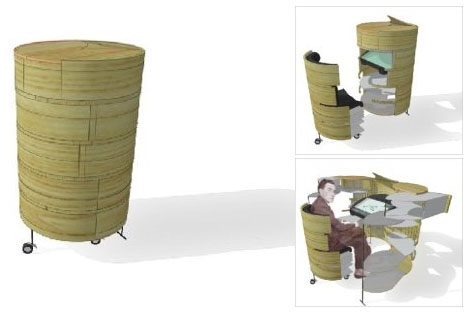
[above: The Design Pod mobile office concept by Andrew Maynard]
What if you could simply reuse packaging as part of a product rather than sending away for disposal or recycling? Some industrial designers have taken up the challenge with varied results. Like creative flat-pack designs, the constraints of the projects become opportunities for self-expression and to (literally) think outside the box.

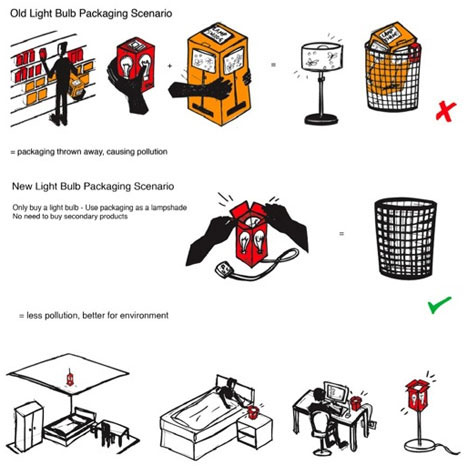
Olivia Cheung is a conceptual artist and product designer who specializes in three dimensional design with an emphasis on popular culture. One of her projects involves light bulb packaging that also takes on the function of a lamp shade. In principle this is simple, in practice it combines entertainment, reuse and feasibility.
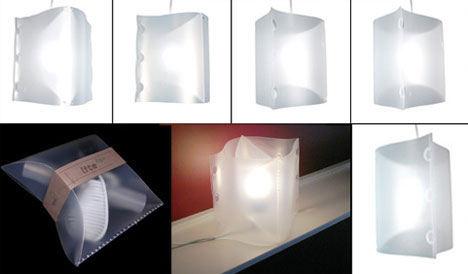
Knoend is a commercial company that has put into practice Cheung’s design concept, creating semi-transparent and still-elegant packaging that conveniently folds out into a surprisingly appealing minimalist light cover for the purchased fixture.
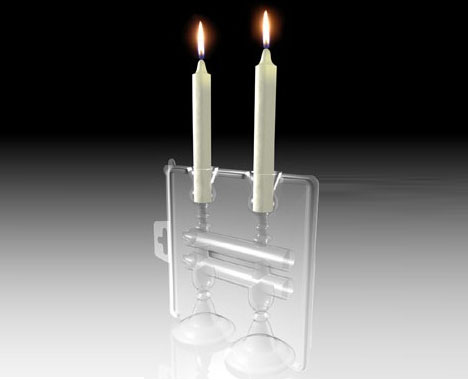
Zero Thick has another solution the the package-as-product problem. It perhaps isn’t as elegant, but it also doesn’t aim to be. In a very modernist way the packaging is expressive of its multiple purposes and shows both its final use (as a candle holder) and its prior purpose (as a candle package) quite clearly and creatively. For more compact furniture check out this collection of transformable and convertible urban furniture.
|
Posted by Urbanist February 1st, 2008 Environment, Urban Furniture, Urban Videos, Various Comments: 26 |
Comment from John Lampard
Time: February 1, 2008, 8:13 pm
I wonder if the Design Pod mobile office could be motorised? Then it’d be the ultimate cool mobile office :)
Comment from Dunk
Time: February 2, 2008, 10:17 am
Some fantastic ideas there. Packaging does seem to be something that designers are focussing on these days. If value can be added to the packaging then it becomes a non-disposable waste of resources.
Comment from pdubs
Time: February 2, 2008, 10:43 am
This makes sense logically.
But it won’t become reality until it makes sense emotionally.
I know that these examples are very crude, but ideas like this won’t become exciting and mainstream ready until the packaging disappears when the products are in their usage stage. That is what is necessary for this idea to scale.
I love a challenge, let’s do it!
Comment from dallasdano
Time: February 2, 2008, 11:06 am
Office pod isn only a “concept.” Would like to see a real one. The lightbulb in a box without the lamp is…well…lame. I’m fond of my light fixtures.
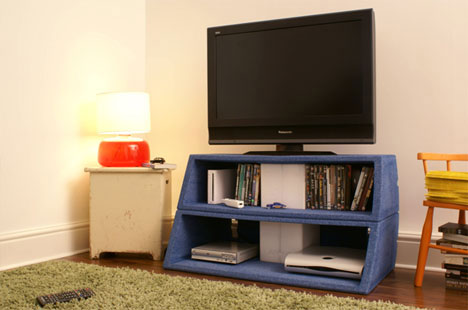
The only really neat idea is the TV box. It seems to make the most sense.
Comment from Rob
Time: February 2, 2008, 11:31 am
Seems like a good start. One problem I see is the furniture will get scratched up during shipping. Maybe make the interior of the furniture the exterior of the shipping package. There would be more assembly time, but I think the design options would open up.
Comment from Damien Taylor
Time: February 2, 2008, 11:56 am
These are fantastic, not only ecological but political. Brilliant stuff, what a great way to capture materials no one thinks about and re-purpose them into not only a statement, but good looking things as well!
Comment from Mike
Time: February 2, 2008, 12:27 pm
The future apparently blows.
Comment from Dona
Time: February 2, 2008, 12:45 pm
This is really cool! Thanks for this article and for the interesting ideas :)
Comment from Eric
Time: February 2, 2008, 2:03 pm
This is stupid. The ‘packaging’ will just be thrown away later rather than earlier. That’s not doing anything good to the ecology. And the very fact that all these solutions require you to buy something new to replace something you already have doesn’t help.
Comment from jjty
Time: February 2, 2008, 2:45 pm
ugly. every single one of them.
Comment from WebUrbanist
Time: February 2, 2008, 4:02 pm
Indeed packing getting bruised could be a problem, Rob, and you’re welcome Dona! Eric: one of the things to keep in mind is that by making the packaging part of the product you actually do reduce net waste because that is one less item being produced (i.e. the packaging is not created in addition to the product). So, while it will eventually have to be discarded either way fewer things are created in the first place.
Comment from Adam
Time: February 2, 2008, 8:11 pm
Most of these only look clever on the surface but do not solve anything. The “candlestick” package is the worst; it doesn’t have the weight of a real candlestick, and it has a large surface area. The draft from opening a door would easily knock it over, making it a serious fire hazard! The lightbulb with lampshade-as-packaging is simply wasteful; instead of buying one lampshade (which are often sold with minimal or no packaging), you would be paying for and wasting a lampshade every time you replaced the bulb.
Comment from jim
Time: February 2, 2008, 9:08 pm
the light bulb design would save on the package but would urn the house down!
do you know how hot a bulb gets even after a few minutes on use?
Comment from T-Shirt Azusa
Time: February 2, 2008, 9:53 pm
Agree with many comments. Concept is great, but only seems to work with the TV stand. The other designs are eventually going to be thrown out or need to be tested for practicality.
I revisit the theme of packaging for my own company, trying to keep excess at a minimum. It’s not easy given that mailed items will get dirty, and the packaging has to provide some buffer to protect the product itself. (Would love to hear input if anyone has any!)
Kind of related, but maybe not as cool looking, are some grocery store sandwich meats that come in plastic containers! Just like the Ziploc ones that you would otherwise pay for, and totally reusable for bringing sandwiches or soups to work :)
Comment from Will
Time: February 3, 2008, 3:48 am
Looks totally bogus to me, in this world I would have to trade the usefulness and cost of the item (say the TV) with whether the box will look good in my room, plus the sacrificial surface stays on the outside, meaning that they will have to be packaged twice or the shop won’t be able to ship them in dirty trucks.
And as for the candlestick/light bulb you replace ornamental fixtures with functional plastic and environmentally cheap (compostable or power from waste - simply folded recycled card) packaging with environmentally poor injection formed plastic.
Comment from WebUrbanist
Time: February 3, 2008, 6:39 am
The volume of negative comments is kind of surprising. Mostly, these are ideas revolving around a concept: that of using product as packaging. It’s hard to see how the concept would be problematic, though clearly the implementation isn’t foolproof in some of these cases. Perhaps the best thing to do is to overlook the details and consider/imagine further possibilities.
Comment from John Leeke
Time: February 3, 2008, 9:00 pm
Fancy design is no excuse for excessive consumption.
You know darn well that the TV box will be packed in a cardboard box, or else FedEx will slap an additional $12 charge on the shipment for “non-standard packaging”. Also the cardboard will probable be wrapped in plastic at least three times so the petro-chemical pirates will be able to steal their share of your dollars. Then, when you actually do reuse all your packaging and generate zero waste at your household your local waste collection company, in collusion with your local government, will slap you with a lawsuit on you for your not paying them to haul away the waste you do not generate. (base on an actual case)
so, the only real solution is to not buy the TV in the first place. So, what will you do with your time? How about make friends with your neighbors, or read a book.
John (just about had it with excessive consumption) Leeke
Comment from Webomatica
Time: February 7, 2008, 4:49 pm
While several of these don’t look that great, the one of the lighbulb / lampshade package is pretty cool. Otherwise - our cats like to sit in all the cardboard boxes we bring home, so someone should consider cat beds as another option :)
Comment from nbh
Time: May 1, 2008, 10:13 pm
I think the TV packaging could work well with products targeted at students or young adults. Economics trumps aesthetics in some cases.

Write a comment