If you are new to WebUrbanist, click here to sign up for the RSS feed and take a look through our archives and galleries

(Check out our complete collection of Green Art, Design and Technology.)
Imagine the world in 2050 with almost 80% of the planet’s population living in urban centers and our fruit, vegetables and even animals are grown in … skyscrapers? One man’s vision has sparked a series of designs leading closer and closer to what will be the first real-life vertical urban farm in Las Vegas, Nevada of all places. Here are five of these remarkable architectural designs for sustainable (and stylish) urban farm towers that may revolutionize agriculture as we know it. In the long run such structures may not only provide food for hundreds of thousands of people per building but they will also relieve much of the burden on other flat landscapes where fewer and fewer usable growing spaces exist.
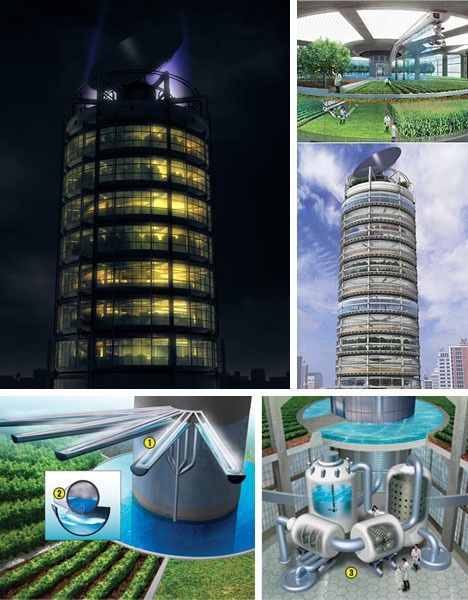
One of the first designs of its kind, the compelling vertical farm project above was undertaken by Chris Jacobs in cooperation with the grandfather of skyscraper farm concepts: Dr. Dickson Despommier of Columbia University. His ideal: all-in-one eco-towers would be actually produce more energy, water (via condensation/purification) and food than their occupants would consume. His mission: to gather architects, engineers, economists and urban planners to develop a sustainable and high-tech wonder of ecological engineering.
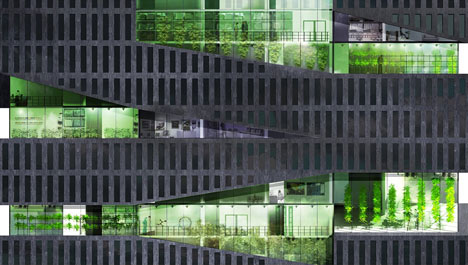
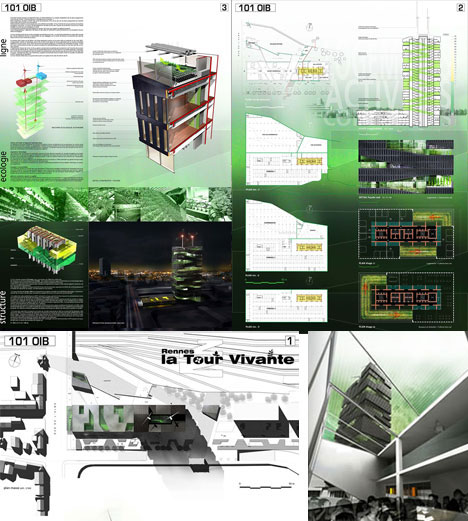
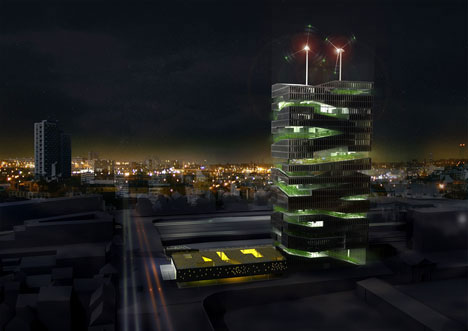
Architect Pierre Sartoux of Atelier SOA has gone a step further and put some serious design talent behind his proposal for a vertical farming skyscraper. A light-shading skin wraps around the structure and opens to admit sunlight at particular locations for various functional (and aesthetic) purposes. The building’s air, heating and cooling systems are wind-driven and circulate oxygen and carbon dioxide between growing and living spaces. The simple but reinforced structure is designed to handle additional dead loads from the weight of growing floors and also serve to make the entire building more durable (and thus sustainable).
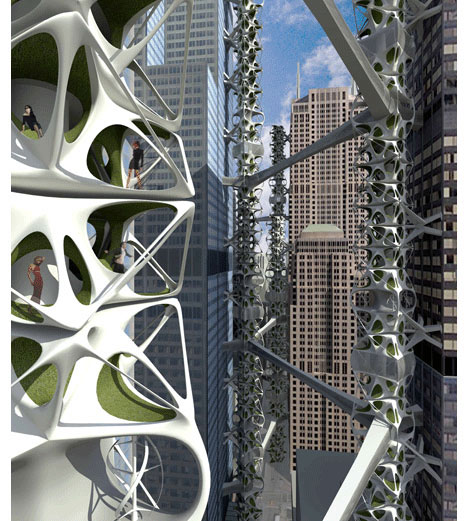
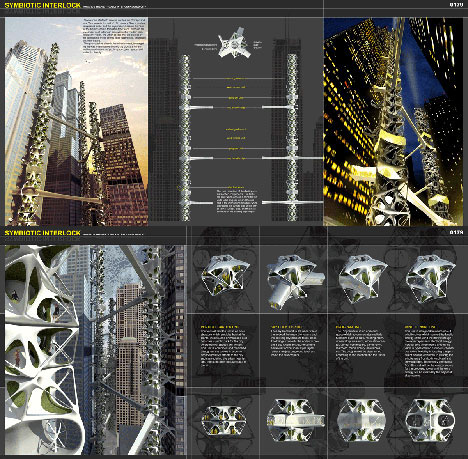
Given that most urban cores are already densely built, one designer has proposed an auxiliary series of structures to be attached to existing structures in downtown areas. These modular constructions would provide garden and recreation spaces for residents as well as light and air filters for the adjacent buildings. In some cases, these retrofits could even provide structural stability to aged buildings and prevent the need to tear them down. Architecturally, these modular units stand out and add another layer to the visual hierarchy of the cities around them.
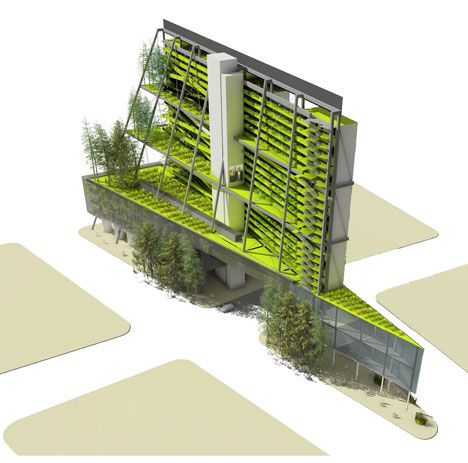
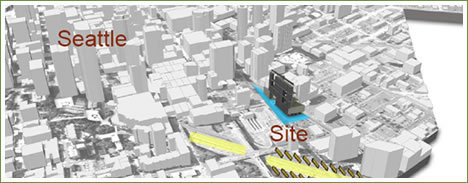
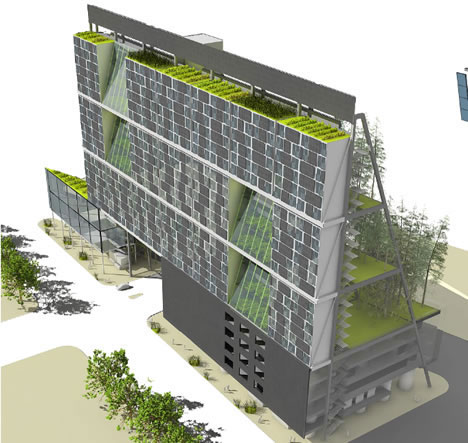
The Pacific Northwest regional architecture firm Mithun developed a compelling vertical farm building design to incorporate various green building strategies in a mixed-use residential and commercial complexdesigned for downtown Seattle. The concept? Simply put, the structure is designed as a kind of built organism - completely self-sufficient and adaptive to its surroundings. The design includes water and energy self-sufficiency from rainwater and gray water collection and reuse, solar cells, vegetable and grain growing spaces and even a chicken farm - all built on a small-footprint downtown urban lot.
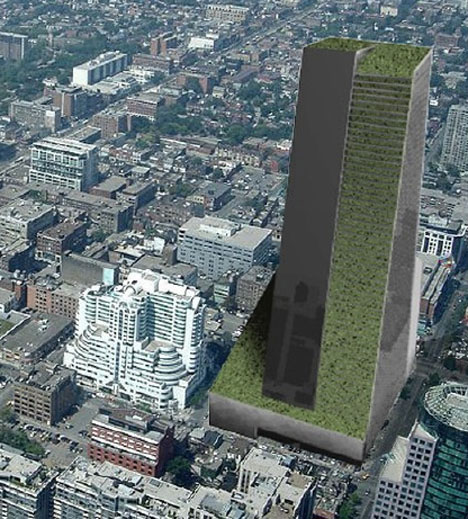

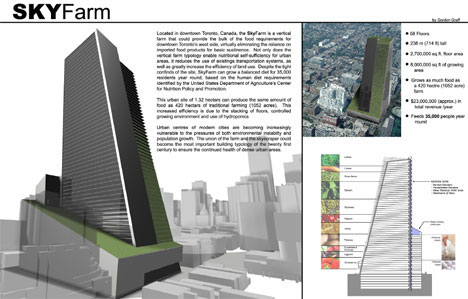
Architect Gordon Graff may succeed in the more green and progressive city of Toronto with his plans for a sky farm with 48 floors and millions of square feet of floor space (and even more growing space). This building, if constructed, will be able to feed tens of thousands of people per year. Best of all, particularly in Canada, the success of the building’s crops isn’t contingent upon climactic conditions. As an architectural and urban design gesture this structure both fits into the city skyline and differentiates itself with simple layers of green.
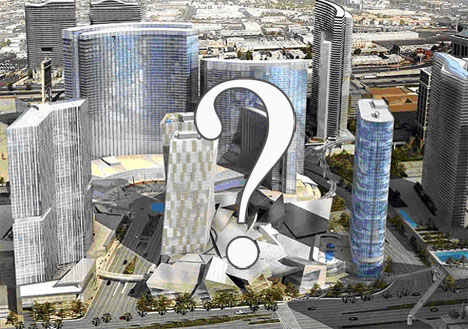
Depending on your point of view Las Vegas might be the first or it could be the last place you’d imagine the 30-story world’s first vertical farm. Of course, the food isn’t going to feed the famished masses. It will instead grace the dinner plates of Vegas tourists at local casinos and hotels. Still, as a prototype it has a lot of potential to generate further buzz and interest that could in turn lead to future projects. If the model proves both profitable and sustainable (always the best combination) it will likely (and hopefully) be the first of many.


67 Comments
March 30th, 2008 at 3:08 pm
how great will it “be” .
March 30th, 2008 at 5:10 pm
Hi,
I remember when kid seing those sci-fi movies, such as Space 1999, and when they showed those scenes with agriculture : this will be the future.
And if we think about it, screenplayers, movie directors, writers, they are often visionaries. And what we often see in movies is what will be the future.
One of those examples is in my opinion the movie Total Recall.
I find this project to be visionary.
And I just hope that we don’t follow the way of profit at all cost instead of quality.
Kind regards,
José
March 30th, 2008 at 5:13 pm
Too much capital is required for such little return.
March 30th, 2008 at 7:50 pm
your probably right Jose… Total Recall could be based on reality… Philip K Dick, the writer, as been known to foresee the future.
As for these agro buildings… I really hope we start seeing them soon. It would probably be easier to keep pests out and grow organic food more easily. Also anything that brings more green into city centers would be great to have.
March 30th, 2008 at 8:03 pm
A reflective shell that would spiral down slowly by gravity somehow would be a neat way to give light to the other side. If solar panals were added with the reflectors, then that energy could be stored to raise the reflectors back to the top.
Something like this would be a great platform for wind energy.
I think the whole thing should be more open with a central spire with platforms.
Smaller versions in an orchard style would be interesting.
March 30th, 2008 at 8:17 pm
It would be nice to have all these buildings, but is it practical?
March 30th, 2008 at 8:32 pm
I’m sure that once 90% of the rain forest is gone and our agricultural breadbaskets have been turned into huge dust bowls by factory farming, these will be producing plenty of ROI.
March 30th, 2008 at 8:40 pm
Man, Captain Planet sure sold out to the big C.
March 30th, 2008 at 8:59 pm
I can say to myself.It’s so great!
March 30th, 2008 at 9:16 pm
Indoor agriculture is energy intensive - whether in a futuristic skyscraper or lowly greenhouse. That’s why it’s rarely used for production, but instead for starting seedlings or breeding.
The truth of the matter is we’ve got plenty of surplus land for farming, especially in the US with our relatively low population to acreage ratio. And despite claims by the agribusiness industry, a diversified polyculture grown in a sustainable, organic agricultural system can produce much higher yields than monocultures of chemical dependent row crops. The catch is it requires critical thinking and more labor than the one size fits all perspective of conventional agriculture.
Is building an energy and capital intensive skyscraper really the best way to feed urban centers - which local agriculture is already perfectly capable of doing?
System like this really only make sense for producing crops that otherwise need to travel long distances to reach market, such as tomatoes in December in Chicago, or bananas anywhere in the continental US.
Ironically, if more people lived in skyscrapers instead of sprawling suburbs, there would be less pressure on the food distribution network and less farm land lost to development. Perhaps it makes more sense to put people inside skyscrapers instead of soil?
But in any case, our agricultural problems are more a matter of economics and technique than anything else.
March 30th, 2008 at 10:15 pm
Leafy greens are ideal crops for this situation. The Hmong refugees who arrived in the early 1980s were able to produce huge gardens of leafy vegetables on the steep, very poor soils of urban railroad right of way, even with slope of 45 degrees or greater. It would be largley a social problem of educating people to urban agriculture.
March 31st, 2008 at 12:00 am
I can imagine such buildings combined with living space would provide an excellent envrioment to live in.
March 31st, 2008 at 12:47 am
God bless ecological people
March 31st, 2008 at 12:53 am
i hope i’ll be still alive at 2050 to see all of those things…
March 31st, 2008 at 6:14 am
Good pics , hope they will complete fast and show real.
March 31st, 2008 at 1:58 pm
I want one in my urban sprawl please.
Seriously, how comes with these ideas. Instead of building expansive structures for the food we eat, perhaps we should build expansive structures for ourselves first, in order to make a more efficient use of the space that is available to us. If our transportation systems were a bit more integrated to our urban environment, there would be less of these roads everyone dislike and we’d save a lot of space. Not to mention we could give everyone housing…
March 31st, 2008 at 11:12 pm
good concept, will it become reality ? since I’ve seen a lot of building concept with eco friendly concept, yet none is being built
April 1st, 2008 at 3:06 am
Fantastic and Creative Thinking :)
April 1st, 2008 at 4:20 am
what about all the polution that major cities come with? do you really want ur food grown in acid rain, poluted air and dirty water?
April 1st, 2008 at 10:19 am
why do all the proposals have to be built in seriously expensive skyscrapers? most of the buildings in cities aren’t skyscrapers, even in manhattan.
why not a four-story urban farm?
that actually seems more doable and believable.
April 3rd, 2008 at 7:34 am
I don’t see how this can be cheaper than growing food in the countryside and transporting it to town?
April 3rd, 2008 at 11:25 am
I know it’s a nice idea, but I’m not really for it because it supports global urbanization. Any kind of world, planet, or place entirely lacking plants growing on the actual ground seems immoral to me, and these “farm buildings” say, in a way, that it doesn’t matter if we
burn down all the rain forests, there will still be our artificial “farm buildings” to keep us alive.
April 4th, 2008 at 1:17 pm
CaptainPlanet is right. Has anyone figured what the cost of teh agricultural produce would have to be to cover operating and capital costs with a market-rate profit? Maybe revisit this when corn is $1000.00 a bushel…
April 5th, 2008 at 11:38 pm
Thanks for your good job. It would be good if we could have pictures in a bigger size.
April 6th, 2008 at 8:33 am
@david byrden
David, this is meant to remedy a possible problem in the future where the “country side” is almost non-existent.
As far as cost goes, the way I see it; Judging by some of the deisngs, it would seem possible to renovate an old parking garage into an agro-structure. Although this doesn’t completely cut costs, its cheaper than building a brand new structure.
April 7th, 2008 at 7:16 pm
This is a perversion of nature.
April 11th, 2008 at 4:47 pm
SKYSCRAPER THINKING is still SKYSCRAPER Thinking..
It needs to work as a system of nature, not too much infrustructure. Not an architect’s wet dream, or cynical developer’s alibi.
Communities farm best, whether in the city or not.
Corporations will just dominate the skyline, the skylight and continue to overcharge for what should be almost free.
Hand these plans to organic gardeners, let’s see if it’s profit motivated.
April 14th, 2008 at 2:17 am
Sounds…and looks too cool! I’m sure putting so much nature in a concrete structure will not be easy…for instance putting a tree on the second floor…will not be easy…and the roots penetration will be an issue.
However, man’s domination over nature with steel and all things concrete should take care of it?
April 19th, 2008 at 6:05 pm
good pics
Kristal L. Rosebrook
April 19th, 2008 at 7:01 pm
This is so cool. My professional degree is in Architecture. Seeing buildings like that makes you want to design more.
How about the creations they have in Dubai? Dubai just blows me away. I can’t believe how much they have evolved there.
Keep up the great work.
Peter
April 20th, 2008 at 2:39 pm
They all look stylish, it’ a great idea, but how will the soils keep healthy? Where will the nutrients and soils come from? What happens with waste waster and drainage
April 26th, 2008 at 2:49 am
brilliant …NOT. Growing lettuce in a space that costs $300 a square foot? really? are you stoned or something? How about growing lettuce in a greenhouse which sits on a bed of gravel and has plastic sheets for walls. Maybe costs $5 a square foot. The only way using such valuable space would work economically is to charge the offices and apartments double and triple the normal rent. Unless you can find a market to sell a head of lettuce for $50.
April 30th, 2008 at 5:34 pm
Umm! WOAH! What about Paolo Soleri, the father of the Arcology ? What about Arcosanti, Mesa City, Cosanti ?
May 3rd, 2008 at 9:19 am
Could be a good idea…
Considering the continuous raises in petrol prices, transporting veggies from the country side is becoming very pricey. But so much for “organic” produces.
May 5th, 2008 at 12:43 am
This is amazing..finally something making good use of today’s technology
May 5th, 2008 at 12:49 pm
Soylent green….. it’s….people….
May 9th, 2008 at 8:59 pm
The growing medium used in these structures will be hydroponics, different dynamic than soil growing. Smaller root mass means easier manageability. We already have a serious food crisis, and if something happens to the bread basket of the USA, we need something to fall back on. Although I tend to look more toward Cuba’s less glamorous looking solutions to it’s cities’ food security as a short term solution than this corporate slickness…although this could augment the Cuba greening of cities…
July 6th, 2008 at 9:25 pm
Oh it’s the new architecture of different…..
July 18th, 2008 at 8:00 pm
good concept and creative thinking.
Trackbacks
What do you think? Leave a comment!