• How to Subvert Your House: Buying, Designing and Building Cargo Container Homes


    What’s involved in buying, designing and building cargo container homes that are more than just art projects? Cargo container homes are a perfect example of thinking outside the box while living inside one, but thinking is one thing and doing is another. Careful planning is required before building and moving in.
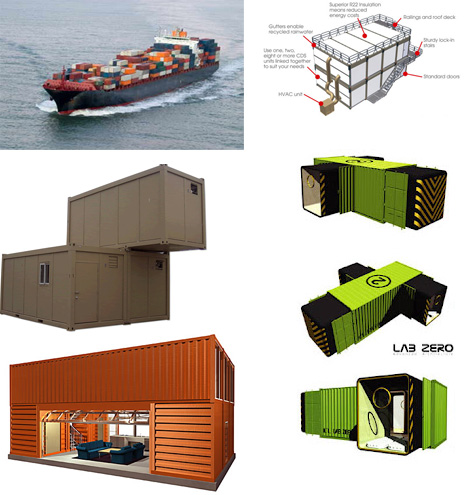
    (image via: Midwest Storage Containers)

    There are several fun and practical reasons to live in a cargo container home. First of all, it’s cheaper for a shipping company to buy new containers than to transport empty ones back to the origin, creating a stockpile of containers in port areas that container home builders in the right place at the right time can obtain for the right price.

    Furthermore, most containers are made of metal which makes them sturdy even when stacked - not to mention resistant to weather, fires, and other natural (and unnatural) elements. They’re available in a variety of sizes (with most common being 8 feet wide by 8.5 feet tall by 40 feet long) that are ideal for modular housing and office use.

    (image via: Sea Box and American Mobile Office)

    Finding a cargo container isn’t all that difficult. There are numerous online shipping/transportation directories like Sea Box (above left) and American Mobile Office (above right) that specialize in pre-fab offices based on former cargo containers.

    So-called bulktainers make the best modules as they are made of metal and have been used to ship dry goods on transoceanic voyages. The container’s ID number can be used to determine the container’s age. Once a suitable cargo container (or containers) has been located and met the buyer’s specifications, you can negotiate a very reasonable price of a couple thousand dollars each, plus shipping to the purchaser’s location.
    (image via: LOT-EK)

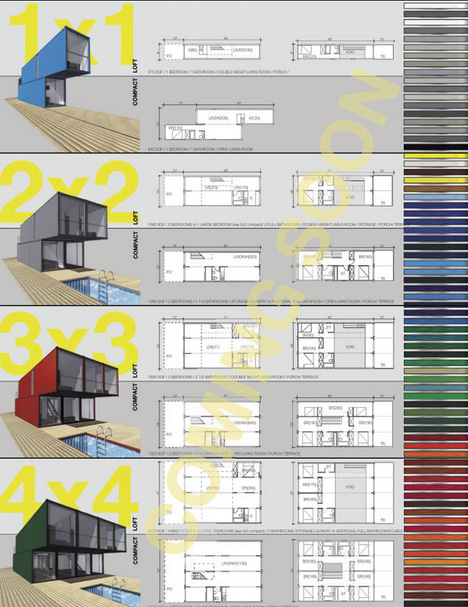
    Depending on what the plans are for the project’s final use, designing cargo container homes is relatively uncomplicated. The modular format necessitated by the shape of the containers tends to limit freedom of expression but also lends itself to practical, form-follows-function formats. An excellent example is the pre-fab, DIY Container Home Kit from LOT-EK that employs 40-foot-long shipping containers joined and stacked in various configurations.

    Building cargo container homes with LOT-EK

    Following LOT-EK’s detailed plans, a stylish, modern cargo container home from 1,000 to 3,000 square feet in area can be built in surprisingly little time.

    (image via: LiveModern)

    Whether it’s a single-family home, small or large apartment, school or community center or even an office complex, cargo containers allow for fast construction and long term sustainable use.

    (image via: Sea Box)

    The most complicated facet of the job is typically installing utilities such as plumbing and electricity, though anyone with at least basic contracting knowledge can handle what’s necessary. If not, companies such as Sea Box will install ready-to-go lighting and electrical systems with cargo containers ordered from them.
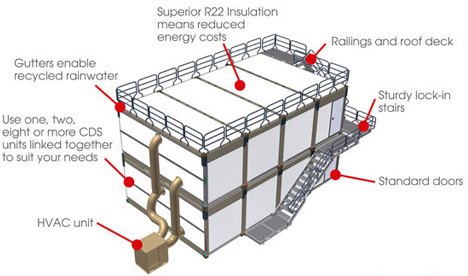
    (image via: Shedworking)

    Checking to see that the project conforms with the local building codes is paramount - luckily most if not all the required information and application forms are available online.

    (image via: Businessweek)

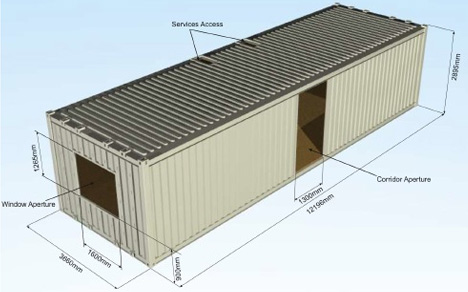
    Small homes are naturally the simplest types of cargo container homes, often requiring just one single large container. In this modular building block, windows, doors and utility access points must be cut with arc welding equipment - a job best left to professionals as mistakes are not easily reversed. The result may look outwardly like an average house trailer but is much stronger structurally.

    Municipal authorities and commercial construction firms have built group homes, community centers, industrial parks and office complexes using low-cost or surplus cargo containers that provide an affordable way to create practical living and working spaces.
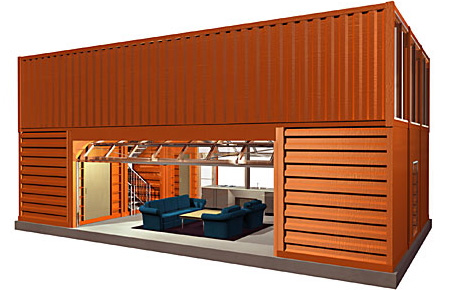
    (image via: LOT-EK)

    Utilizing surplus cargo containers in home, community and commercial construction projects is a common sense solution that solves a number of problems for suppliers, builders and homebuyers. No trees need to be cut down nor does metal have to be mined and smelted. Cargo container home and offices are, in essence, eco-friendly alternatives that are sure to see more widespread application as time goes by and precious resources become ever more scarce.

    Previously: Awesome Shipping Container Homes

    And: More Awesome Shipping Container Homes

    If you are new to WebUrbanist, click here to sign up for the RSS feed and take a look through our archives and urban galleries. Also be sure visit our green twin the wonderful WebEcoist and and see architecture, interiors, fantastic furniture and more designs at Dornob or click here if you need to design a free flash website.

    And on Other Sites See:

    23 Comments

    • Matt
      September 18th, 2008 at 7:20 am

      We posted this few days ago: http://greenupgrader.com/3203/…..even-know/

      but I had not idea how many implementations there are. I love prefab houses and these are industrial cool!

    • PureDezigner
      September 18th, 2008 at 7:21 am

      I remember reading about these things a while back, I don’t about actually living in one though.

    • Intuition
      September 18th, 2008 at 7:21 am

      These containers are toxic. They contain carcinogenic alloys, the paint adhesive is toxic to biomass, and the metal requires signficant treatments for insulation methods that commonly employ high level VOCs. Granted the design concept of reuse is admirable, but the longeviety and health concerns for those who inhabit or live in proximty to these containers should be of higher concern. Consider the FEMA trailer disaster. What would a soil analysis from a container graveyard report? Reuse in desgin does not hold precedence over the health of the inhabitants and the surrounding biomass.

    • ARMEDANDFREE
      September 18th, 2008 at 7:21 am

      Quote: “These containers are toxic. They contain carcinogenic alloys, the paint adhesive is toxic to biomass, and the metal requires signficant treatments for insulation methods that commonly employ high level VOCs. Granted the design concept of reuse is admirable, but the longeviety and health concerns for those who inhabit or live in proximty to these containers should be of higher concern. Consider the FEMA trailer disaster. What would a soil analysis from a container graveyard report? Reuse in desgin does not hold precedence over the health of the inhabitants and the surrounding biomass.”

      You mean it could be worse than the Oil refinery just down the road sending it’s toxins into the air, water and earth? You will never see a soil or any other analysis from it, the chain link fence has barbed wire and they have deep pockets with lots of money to pay the fines. They bought out a quarter of the town to tear down the houses that were filled with toxic material but claimed no fault in the buyout settlement. You could see the brown liquid oozing from the walls of the homes. The water running through a ditch to the river could be lit with a match. The local hospital built a new addition to handle all the cancer patients. Al Gore is looking for people like you to help him. I’m gonna get me a container home and live off hot dogs till the refinery lets loose a toxic cloud. They been handing out kits with plastic and duct tape to shelter in place.

    • erik "maker"
      September 18th, 2008 at 7:22 am

      Have u ever been near a shipping container, because it doesn’t sound like it. There just normal mild steel which is found everywhere, from the car u drive to the oven you cook your food. Then as far as the “paint adhesive is toxic to biomass” their actual a epoxy two part paint system that has lower solvent emission than polyurethane and acrylic coatings, which can be found in your house, car, and office. Now lets talk about common sense to would you really use a container that had previously stored truly deadly toxins. So before you knock it you might want to study a bit more

    • Intuition
      September 18th, 2008 at 7:22 am

      TBT, research it!

      Fraggle rock, be a Doozer!

      Vitruvius, wake him up already?

      Pride, leave it alone!

      The pineal gland, its not your soul?

      If you find my common sense, please do not reurn it.

    • erik "maker"
      September 18th, 2008 at 7:23 am

      Oh boy sorry i hit a nerve =D , kudos on the TBT which is a toxin . I did research the fraggle rock and doozer and the Vitruvius Comment, sooooo are you calling me a Muppet or a Roman writer, architect and engineer, didn’t really get it. agreed that i do have a since of pride when it comes to metal objects because thats what i work with, but now the thing about my soul being the pineal gland i don’t get, i mean i know that “some” say its the “seat of the soul”. All i know is that it helps me sleep and wake up.
      oh and about your common sense I did find it….. it was in a shipping container.

    • Jeff Mar
      October 8th, 2008 at 12:14 pm

      Does anyone know how I can find these containers in my local area(southern Maryland)? I figured there would be plenty around the port in Baltimore but have not been able to locate a company yet… help?

    • Anthony Tsang Yee
      October 15th, 2008 at 3:33 pm

      Here is a thought. If the insulated containers can be stripped of their dangerous paint jobs we still have a premier form of ready housing. These containers must be of the insulated variety. Folks who are already trained in cutting out doors and windows with torches will find ready employment. These types of containers will need less heat and air conditioning to give their owners comfort. If there is a surplus or trailers to transport these containers, they will make a ready on site foundation. There is also the thought that these containers mounted on barges that can be floated down their final destinations. These barges will have to be dragged onto their cement footings. There may be a need to tether these barges to poles at all four corners to survive any kind of flooding scenerio. The area below, if made water proof (the hold below) would be perfect for storage and more sleeping quarters. For those units traveling on trailers, the trailers have
      mechanisms to raise them off the ground and leave the tires free from quick degradation. In other words instant foundation. This is a much better situation then the present conditions of FEMA trailers that exude toxic fumes from the pressed wood used in the interiors.

    • Anthony Tsang Yee
      October 15th, 2008 at 3:41 pm

      Here is a thought. If the insulated containers can be stripped of their dangerous paint jobs we still have a premier form of ready housing. These containers must be of the insulated variety. Folks who are already trained in cutting out doors and windows with torches will find ready employment. These types of containers will need less heat and air conditioning to give their owners comfort. If there is a surplus of trailers to transport these containers, they will make a ready on site foundation. If the land is stable. If the land is not stable then other methods must be used to insure stability. There is also the thought that these containers mounted on barges that can be floated down their final destinations. These barges will have to be dragged onto their cement footings. There may be a need to tether these barges to poles at all four corners to survive any kind of flooding scenerio. The area below, if made water proof (the hold below) would be perfect for storage and more sleeping quarters. For those units traveling on trailers, the trailers have mechanisms to raise them off the ground and leave the tires free from quick degradation. In other words an instant foundation. If this is not possible, then a solution must be designed to insure a stable foundation in the long-term sense of the term. This is a much better situation then the present conditions of FEMA trailers that exude toxic fumes from the pressed wood used in the interiors.

    • JohnJ
      November 2nd, 2008 at 12:53 pm

      Jeff Mar, please contact me. I’m in the same area and wondering what stage of design you are in (assuming you’re shooting for a home).

      weburbanist-at-tno.org

    • Flug
      November 10th, 2008 at 8:47 am

      Well, just take a look at this one: http://www.alho.de/bausysteme/.....piele.html great buildings and they are all made of containers!

    • Faith Mccullough
      November 12th, 2008 at 5:40 pm

      88l9gryfhzzahqjs

    • cindy
      January 9th, 2009 at 3:08 pm

      I make all kinds of things out of these shipping containers. check out my website at http://www.container-creations.com. We’re shipping over seas all the time.

      C

    • b0b e.
      May 5th, 2009 at 12:47 pm

      when i view your website i can’t see any jpg’s. all i get is a red “X” in the upper left corner where the pic should be.
      what am i doing wrong?
      thanks,

      b0b1@yahoo.com

      “b” “zero” “b” “one”@yahoo.com

    • RG
      May 24th, 2009 at 10:48 am

      check out logicalhomes.com

      these container homes are unreal. this company just started business and I’m researching everything they’ve done. met the architect and will post back soon with my findings

    • Thomas , Zauberer Zauberkünstler
      May 30th, 2009 at 10:26 pm

      Hi there,
      I found great ideas and discussing on your Web site.
      Well done ! Thanks for that and keep on doing
      Greetings from germany , Thomas

    • Tina
      June 6th, 2009 at 2:31 pm

      Do you think that the containers could be used for an earth home? If so, what do you recomend to prevent them from rusting or moisture barriers.

    • dave l
      June 28th, 2009 at 6:14 am

      container home information

    What do you think? Leave a comment!


    Visit Our Partner Sites: