(Check out our complete collection of Green Art, Design and Technology.)
Trees and plants have a kind of flexibility that is both disturbing and inspiring. Left to their own devices they can wrap around objects and create strange works of unintentional art. Properly pruned and cultivated they can be made into curious, compelling and useful shapes of all sorts. From tree furniture designs to unchecked acts of nature here are 25 examples of the amazing malleability of trees. Of course, there are many forms of strange green art and other subversive ways to garden.
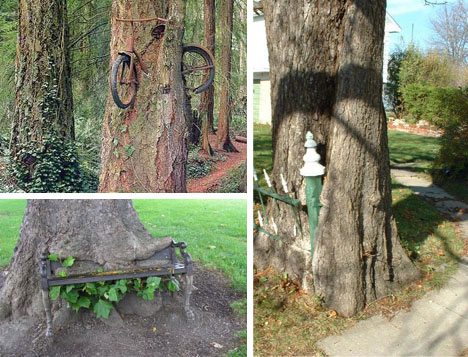
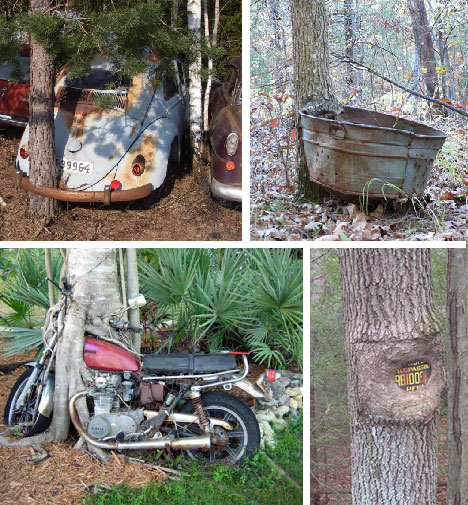
Given time trees can grow around just about anything. Historically, there are a number of legends, rumors and hoaxes regarding man-and-cow-eating trees. Trees that consume people, animals or other objects have also featured prominently in various works of literary fiction such as Little Shop of Horrors.
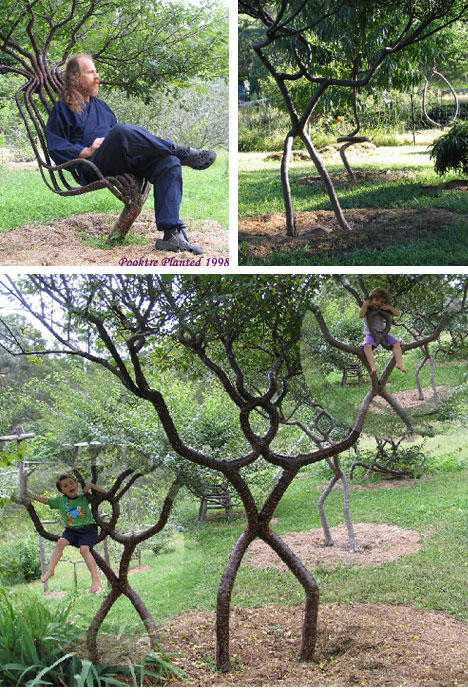
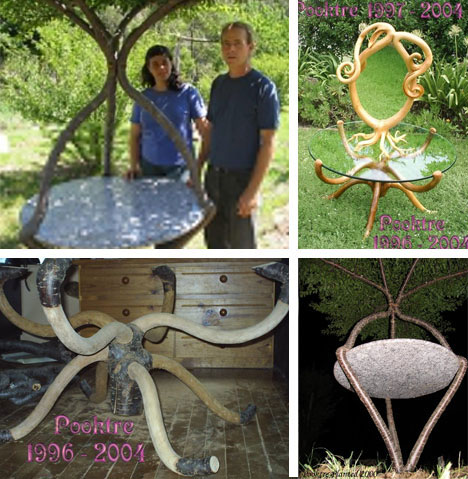
Peter (Pook) Cook and Becky Northey of Pooktre dot Com are two Australian artists and tree shapers who started their love of tree-shaping with a single chair tree. They have since created, individually and jointly, a vast array of tree sculptures, tables, mirrors and other growth-based tree shapes.
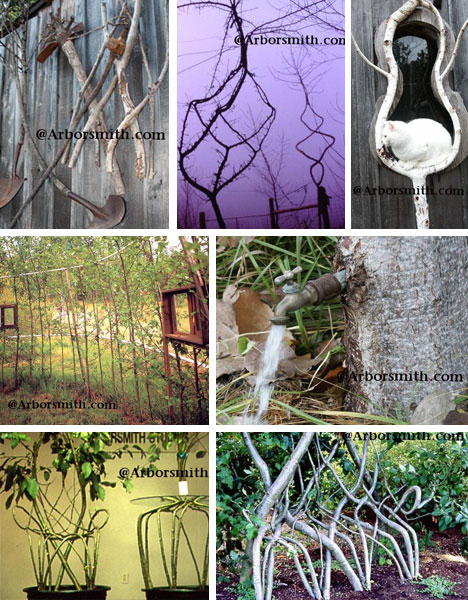
Richard Reams of Arborsmith dot Com focuses more on the artistic side of arbosculpture, creating some meaningful shapes (such as piece signs) as well as whimsically abstract pieces of tree sculpture. Some of his projects (such as grown fence enclosures and tree furniture) do, however, still serve a purpose.
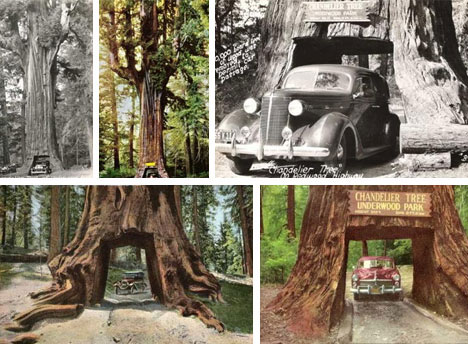
Chandelier Tree is a three hundred foot Redwood tree in California which had a hole carved into it nearly a century ago. While such an intrusion on a magnificent tree would likely not be tolerated today at the time the novelty was considered worthwhile so that a car could pass right through a six foot hole at the base.
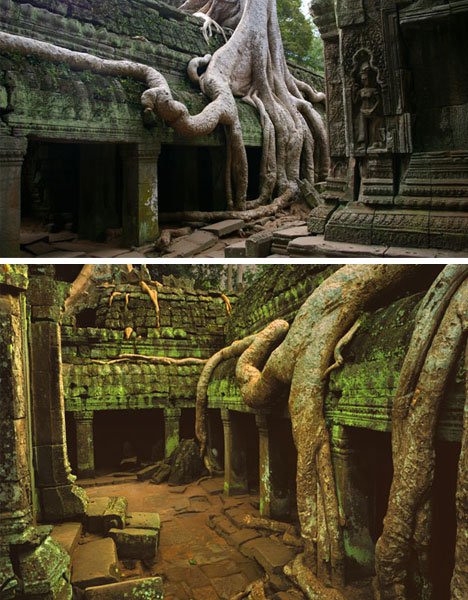
At many historic ruins trees have, over time, integrated themselves into the broken remnants of ancient structures. Of course this can be a problem structurally as the tree growth may compromise the stability of a building but aesthetically it is hard to deny the impressiveness of time as seen through trees.
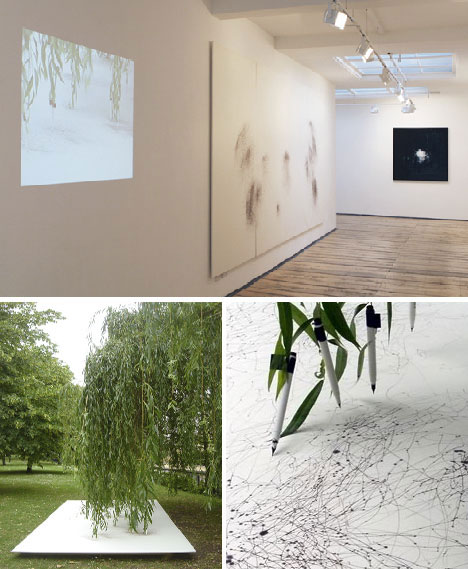
One artist has taken put together the idea of tree movement over time with a more immediate kind of art project by equipping a Weeping Willow tree with fifty pens and then watching the results. The natural shape and sway of this tree lends itself to particularly abstract results. As you can see in the lower right photograph above the results may not be high art but the patterns are at least interesting.
If you are new to WebUrbanist, click here to sign up for the RSS feed and take a look through our archives and urban galleries. Also be sure visit our green twin the wonderful WebEcoist and and see architecture, interiors, fantastic furniture and more designs at Dornob or click here if you need to design a free flash website.


38 Comments
April 22nd, 2008 at 10:51 pm
i think these scenes are very attractive.
April 23rd, 2008 at 8:07 am
Wow, that’s simply fantastic. I couldn’t help but be fascinated by the two bikes and the weeping willow. Weird, but still fascinating, to have the tree draw pictures.
April 23rd, 2008 at 8:42 am
Becky-
Regarding your comment [below]: great additional information on those distinctions in terminology and approach, though clearly one side of a heated debate - thanks for adding that to the article. The article wording has been changed to reflect the ambiguities and differences you mentioned. You are truly a master of your work by whatever name!
April 23rd, 2008 at 9:00 am
Um…im pretty sure those are pens, buddy. pencils dont bleed huge dots onto surfaces when left in contact for long amounts of time.
April 23rd, 2008 at 9:14 am
Hi,
This is Becky from Pooktre.
There are a couple of misunderstandings. Our trees are not arbor sculpture they are shaped trees. There are many different people around the world who shape trees and all of them have they own name for what they do.
Richard has been really important as a focus point for the art form but he does not know how or why trees do what they do. He is on the path but he still hasn’t grown an balanced piece. Richard has said in his own book that all his trees are experiments. Which means he has been unable to recreate his own work. Another thing is, we believe that the way Richard shapes trees is too damaging and leads to unpredictable results. Which is the reason that we don’t wish to have our work confused with arbor sculpture.
We were invited to be the featured artists at the Growing Village World Expo 2005 in Aichi Japan. When in Japan we were told that arbor sculpture does not translate. In Japanese it means to crave away, not shape. At earlier time Richard had grown some trees in Japan which hadn’t worked out that well. We were asked if we wish to have the whole art form called Pooktre or Circus Trees. We felt that as Axel N. Erlandson had done his trees first and well, that we where happy to have our trees associated with his. So in Japan at the Expo the trees were call Circus trees. We are quite happy to have our trees associated with people that have masted their art. Example Krubsack who grow a chair on his first try or with Chis Cattle who has masted that way he shapes the trees and is able to reproduce the same design again and again. Which means he has a understanding of how and why the design works.
Becky
April 23rd, 2008 at 9:42 am
They should include the tree from Pearl Harbor in the list
April 23rd, 2008 at 12:30 pm
Those are some cool shots. It is amazing that trees can absorb those objects and still flourish. I like the tree art too and I enjoyed Becky’s insight.
April 23rd, 2008 at 6:58 pm
Realmente é um tanto interessante, eu já tinha estudado sobre o assunto a alguns meses, o que mais me chama atenção é essas formas que elas tomam ao longo do tempo.. O contra é que por mais que vc trabalhe em cima da forma, um dia vc morrerá e não poderá contemplar o seu projeto, lembrando que isso dura anos para modificar junto com a natureza.
April 24th, 2008 at 1:56 pm
Hi,
This is Richard from Arborsmith Studios.
I’m going to rebut some of the inaccurate comments by Becky.
I have reproduced many of my original designs. My most popular installations are my living chairs, benches and gazebos.
I have also grown many balanced arborsculpture see http://www.arborsmith.com/balance2.html my style of leaving the arborsculptures to live as long as possible instead of harvesting when they are at their perfect point does not lend itself to growing balanced arborsculpture.
The statement that “he does not know how or why trees grow the way they do� is simply not the truth.
I consider my work experimental because it is my way of saying that I am always learning from my trees.
Every artist is allowed to call their art whatever they wish. I call the work of Erlandson, Cattle, Krubsack, Pooktre and all the others that have worked with the trunks of trees “arborsculpture� because it fits the definition.
Everyone who approaches this art form does it in their own style. I believe the real advancement of the art comes as arborsculptores work outside their comfort zone and push the envelope through experimentation and collaboration.
Richard Reames
Arborsmith Studios
April 25th, 2008 at 9:18 am
Some are really famous and i some of them save, but some look fakely for example the bicycle.
April 26th, 2008 at 7:53 am
Hallo, I’m a tree.
We trees don’t mind being part of your art, however we insist that you stop cutting down the Amazon.
April 28th, 2008 at 10:49 pm
Hi
Becky again,
Two flexed trees grafted together will stay balanced. An unbalance piece with an excuse is not example of a balanced piece.
Richard says it is the wind and suns fault. I say that it is the Arborsculpture techniques. The problems seem to arise once you go beyond the tree normal flexing range into the Arborsculpture bending techniques.
In Richard Reams book Arborsculpture Solutions for a Small Planet. Quote
“I’m often amazed at just how far branches will bend without breaking.â€? Unquote (So if you can’t see the damage it alright?) Quote “When making a sharp bend all at once, it is important to use both hands making little bends all along the curve. This technique can keep a sapling from breaking as it “un-localizesâ€? the bend, that is to say spreads the bend out over several inches instead of just in one spot. Bend the tree a little here and little there, using two hands decreases the chance of breaking.â€? Unquote (So let’s spend the damage and hope the branch doesn’t break?)
The cambium is a delicate layer between the bark and timber. Depending on the amount of bend, the Arborsculpture technique can cause damage from mere bruising the cambium layer to damaging all the cells in the branch and cambium cells beyond repair.
I haven’t seen a photo, of a mature balanced Arborsculpture. I have seen lots of photos of newly bent pieces.
I would love to see a clear photo, one of the chairs, bent using the methods as described in Richard’s books and on his website. Preferably one that has had the shaping done to it for 3-4 years, as by this time it is clear how much damage has be done.
April 29th, 2008 at 12:05 pm
Hi!
I am a tree from the Amazon, and hate being cut down too, but the nice folks here want the good life, just like you. Malls, freeways, airports, supermarkets etc. So what’s a tree to do? Guess we should just with hold our oxygen and warm up the planet, they’ll all die off and we can go on being huge trees. hlr
May 4th, 2008 at 3:12 pm
That’s “peace sign”, darling. With an “a”.
May 4th, 2008 at 7:32 pm
I do believe this is very catchy however putting the trees through this kind of pain I feel is horrid.
May 8th, 2008 at 12:09 pm
Wow there are certainly some art work here. I love the bike in the tree..I have a tree in my yard where I had a folding metal chair up against..well after years of being there the tree grew right around it . The chair is part of the tree only way to get it out is to cut the tree and that is something I dont plan on doing. The pictures were amazing nice to see something different ,. I really like the the picture with the guy sitting in a tree that looks like a chair..way cool.
thanks for sharing
Darlene
June 1st, 2008 at 4:09 pm
if you think tree grafting is horrid, youve never seen the pecan region of the american southwest… some trees cannot grow without help, you know…
February 10th, 2009 at 1:43 am
I particularly like the tree-drawing thingy. =D
February 16th, 2009 at 4:49 am
Great collection of marvels! I’ve been admiring Richard Reame’s arbosculptures for years, and I discover here even more ideas inspired by trees. Bravo!
I’ve been working for several years with this fact that trees can integrate objects during their growth. On my website (www.primeau.qc.ca/coexis) I collected several pictures of what I call Gourmand Trees, or Coexistence Trees.
Looking at these trees, I speak freely of Coexistence, because I want to artistically see these trees as a message from nature that illustrates tolerance, coexistence and acceptance of differences.
And the most astonishing: When I visited Jerusalem in 1999, I discovered a Coexistence Tree where the Jewish and Arab quarters meet in the old city of Jerusalem. I wanted to see it not as a simple coincidence, but as a way to help peace emerge from the environment itself…
The tree there should be seen as an example of peace and harmony between peoples and cultures. It is all the more powerful a symbol in view of the conflict in the region where it joins the two sides. To be continued…
February 23rd, 2009 at 10:19 am
What can I say? IT’S AWESOME! Wonderful trees.
Trackbacks
What do you think? Leave a comment!