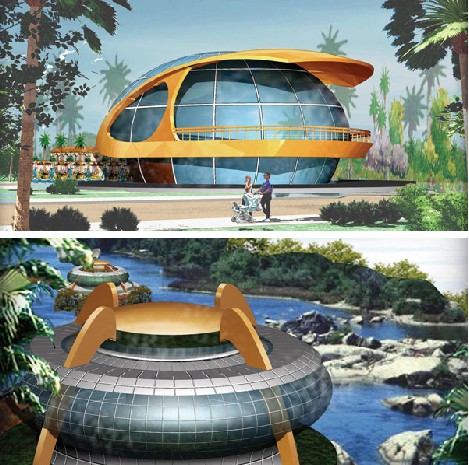
Architects have always aimed towards building bigger, wider and higher (and, recently, more sustainable as well). Now technology has made a fourth design dimension possible: movement. These 15 amazing structures shift their shapes, put a new spin on style!

(image via: Everingham Rotating House)
Don’t like the view out the window? Change it! That’s what the designers of the Everingham Rotating House had in mind when designing this quaintly styled spinning cottage. Thanks to perfect balancing around a precisely located center of gravity, a motor no bigger than one used to power an average washing machine can turn the house a full 360 degrees in about 2 hours.
(image via: RotatingHome.com)
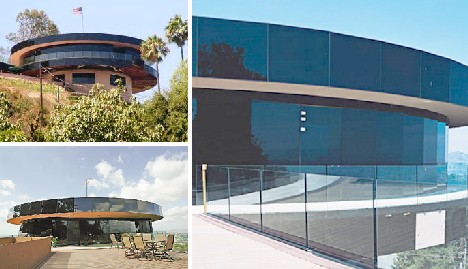
Al and Janet Johnstone of Mountain Helix, CA, think their rotating home is so cool, they’ve patented their plans. The heart of what the Johnstones call – wait for it – the RotatingHome is a SWIVEL mechanism that allows rotation in either direction without disturbing utility connections. A RotatingHome can be set to spin once every 30 minutes to once a day.
(image via: Inhabitat)
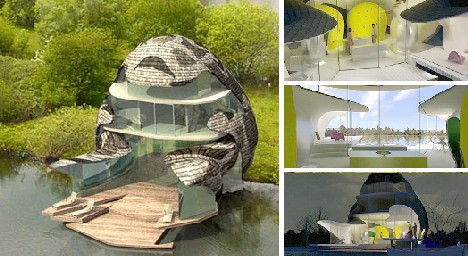
The Orchid House takes kinetic housing to the next level. While its outer walls, supporting members and central core are fixed, the interior non-loadbearing walls can be shifted in a number of directions so that each room is just large enough for the owner’s needs. The home includes a sun deck that fans out over the water, supported by pontoons. The Orchid House may look somewhat rustic but it utilizes the latest in green technology – geothermal heating. Very much a work in progress, the beautiful orchid House is set for completion in 2011 and recently sold to an anonymous buyer for a whopping $14.2 million!
(image via: Trendhunter)
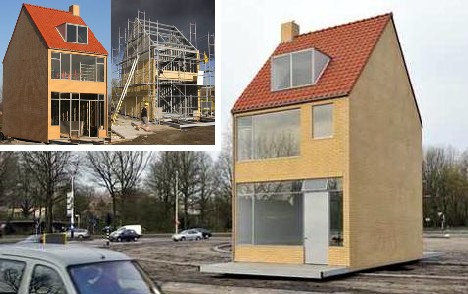
Revolving is another way of injecting a little kinetics into a structure, as demonstrated by artist John Körmeling’s house in Tilburg, The Netherlands. Check out the house in action here:
John Körmeling’s house in Tilburg, The Netherlands
Körmeling’s house is affixed to the edge of a large turntable powered by solar panels on the house’s roof. It makes one full circuit every 24 hours, which is (hopefully) slow enough for passing drivers not to be overly distracted. Körmeling’s house is strictly art – it’s not designed to be lived in.
(image via: msnbc)
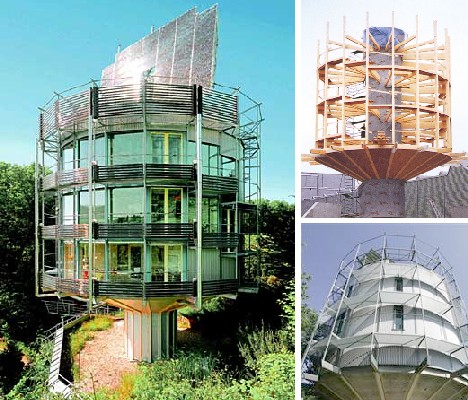
Scaling things up, here is the Heliotrope House in Freiburg, Germany. Designed by visionary “solar architect” Rolf Disch, the Heliotrope House rotates very slowly, just enough to track the sun and ensure the sail-shaped solar energy collector on the roof receives the optimum amount of sunlight.
(image via: Wired New York)
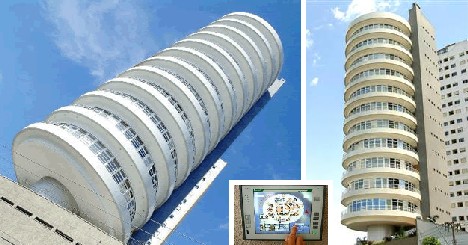
Dense urban settings lend themselves to highrise buildings and even though the engineering is more complex, designers have still found ways to add motion to their creations. Take the Suite Vollard apartments in Curitiba, Brazil. Completed in 2001, the modernist edifice features 11 rotating stories that turn 360 degrees independently of one another. The apartments at the Suite Vollard are sold by the floor, which eliminates any squabbles with the neighbors over who gets the best view. Pricing is surprisingly reasonable as well, just $300,000 for each unit.
(image via: High Rise Properties)
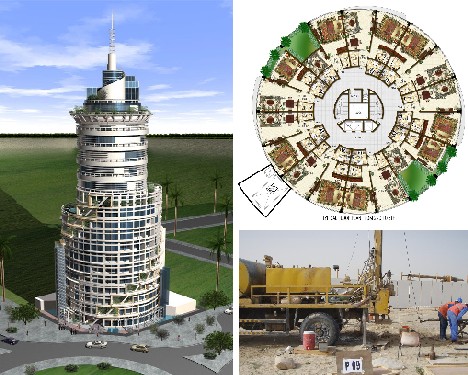
Even more spectacular designs are leaping of the drawing board; nowhere more so than in Dubai. The oil-rich city has become the poster child for megaprojects and futuristic schemes like palm tree shaped artificial islands and, most notably, truly monumental buildings. The Rotating Residences shown above may not bear the most exciting name but they do promise a living experience that will move you – literally.

(image via: Jaunted)
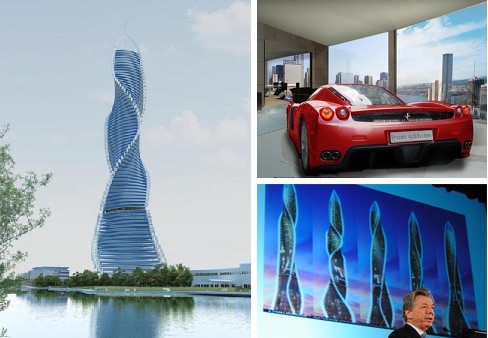
Any mention of Dubai would have to touch on the amazing Rotating Tower in Motion (above), a 68-story wonder by architect David Fisher. Each of the 59 moving floors of the 313 meter (1,027 feet) high skyscraper move at a comfortable 6 meters (about 18 feet) per minute around a central utility spine while integral wind turbines capture the breeze to provide clean, green power. The building will feature a designated parking area on every floor, with the owners’ vehicles being raised and lowered as required by special elevators.
(image via: Dynamic Architecture)
David Fisher has designed a similar spinning skyscraper for the world’s most expensive city to live in, Moscow. Using many of the same design features as Dubai’s Rotating Tower in Motion, the Moscow Rotating Skyscraper is slightly larger – 70 stories towering 400 meters (1,312 feet) high. The building is expected to be completed in the year 2010 and will be constructed much like a familiar infant’s toy, with each pre-constructed module being placed onto the central utility spine.
(image via: Luxique)
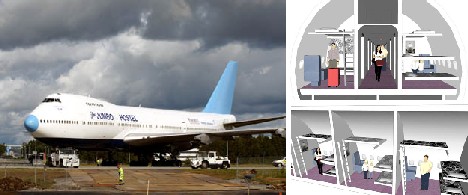
Now not all spinning structures are ritzy digs and not all of them actually move – sometimes just the illusion of movement is enough to suit the designer’s purpose. That’s the case with the Jumbo Hostel, brainchild of Swedish entrepreneur Oscar Dios. Having bought an old 747 jumbo jet from a bankrupt airline, Dios plans to park it near Stockholm’s Arlanda airport and rent out rooms to those who are board with plain hotels. The “plane hotel” will have 25 small rooms and a suite to stretch in place of the old flight deck.
(image via: BLDG Blog)
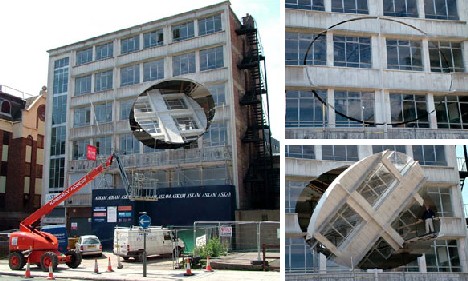
This artistic endeavor in Liverpool, UK, employs motion in an eye-catching way. Richard Wilson cut a 24-foot diameter circle into the facade of an otherwise nondescript downtown building and attached the slice to a rotating pivot mechanism. The result is an odd juxtaposition of 2D and 3D – proof once and for all that “England swings like a pendulum do.”
(image via: DeputyDog)
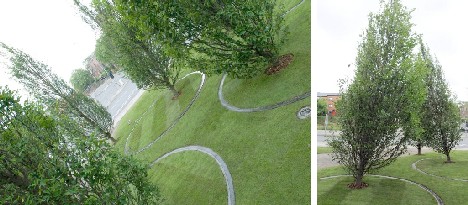
Also from Liverpool is this pastoral arrangement of seemingly ordinary trees… yet things are not quite what they seem. Called Arbores Laetae, Latin for “joyful trees”, the project features 17 trees of which 3 rotate into different positions as the day goes by. The trees are a popular attraction at the British city’s biennial arts festival.
(image via: Ebaum’s World)
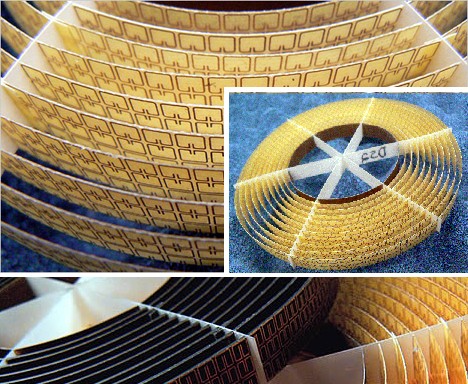
Luigi Colani has designed what very well may be the home of the future, and rotation is what makes it work. The home is compact and modular from the outside but it’s the spin within that gives the house a unique appeal. Central to the plan is a cylindrical section that rotates via a remote control to present a bedroom, a bathroom and a kitchen. The house, says Colani, “was designed for young professionals who need minimal space while they focus on (their) career.”
(image via: Blog Wired)
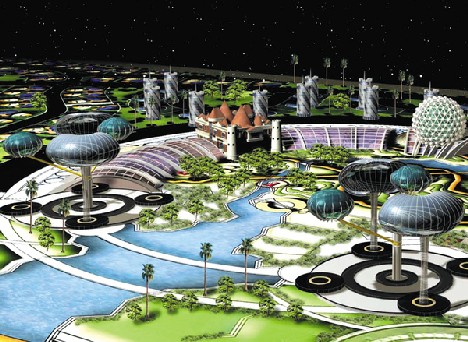
What better place to have a rotating home than in an actual rotating city? Believe it or not, there’s one on the drawing boards. And yes, it’s in Dubai. Contractor High Rise Real Estate submitted an expansive (and no doubt expensive) plan that would see an entire city spring up from the desert landscape. While the new urban center itself wouldn’t rotate, most every structure in it will: stylish villas, ultramodern apartments, swanky restaurants, mega-star hotels and more will be able to swivel, turn and re-position themselves to take best advantage of the sun or shade. Hospitals weren’t mentioned but if they were, you’d find them staffed by spin doctors!