
Last year, WebUrbanist‘s founder Kurt Kohlstedt suffered a debilitating injury that his right arm and dominant hand. New everyday challenges led him to research and test existing adaptive designs, and even to evolve new accessible design solutions. Over the course of a year, these experiences set the stage for Adapt or Design, a twelve-part project of 99% Invisible in three acts. The finalization of this endeavor is accompanied by an episode of the same name featuring Roman Mars.
First, the six-article mini-series Single Handed dives into assistive designs for people with one functional hand. Next, the three-article micro-series Broken Plexus explores design hacks and mods that can help with long-term recoveries. Finally, Left to Write is a three-piece set about adaptive writing technologies, including single-handed keyboards and typing systems.
The project name is a play on “adapt or die,” but it also references a recurring post-injury dilemma: whether to adapt, or to design a fix, absent an existing adaptive design solution.
The project logo design is a nod to the current condition of my (Kurt’s) arm, which awkwardly operates a bit like one of those mechanical grabbers in “claw game” arcade machines.
Act One: Single Handed
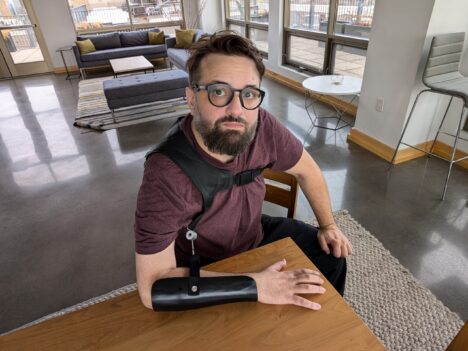
Adapting to life with one working hand, I used to joke that everything was three times harder and took three times longer in the wake of my injury; except, I wasn’t entirely kidding. But the more I identified and addressed everyday problems, the more I was able to reclaim my time, energy, and life … with the help of assistive design solutions.
Part 1 – Design Adaptations for Living with One Working Hand: After a week in the hospital, getting discharged felt great. But simply swapping a hospital gown for street clothes highlighted unexpected issues.
Part 2 – No-Tie Kits, Lace Locks, & Other Assistive Footwear: Shoelaces present a problem; the solution could be cheap, fast, good – pick two. Shoe-lutions include lace locks and assistive footwear.
Part 3 – Inclusive Left-Sided Apparel Embodies “Found” Design: Before shopping for inclusive apparel, it can pay to look closely at one’s wardrobe for clothes that may work with new tools or modifications.
Part 4 – Pack Hack Reconfigures Roomy Rucksack for Crossbody Carry: Sling and messenger bags lack everyday utility and comfort. Absent off-the-shelf options, a backpack can be hacked for crossbody-style carry.
Part 5 E-Ink Devices & Peripherals Render Reading More Accessible: Many recreational options may be out of reach, but e-readers remain accessible, and can be augmented with add-ons for one-handed use.
Part 6 – Hand Lenders Point Out Adaptive Designs & Unexpected Issues: Sometimes those around us are best situated to spot problems right in front of us. They can be great sources of novel adaptive design ideas.
Act Two: Broken Plexus
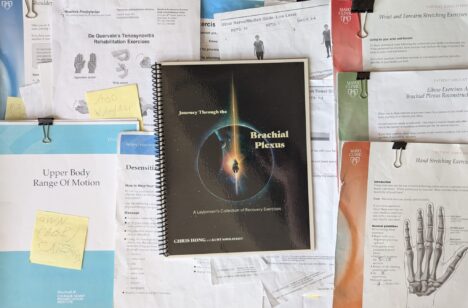
As my recovery dragged on, a series of dynamic long-term challenges emerged, involving change over time. Rehabilitation workout sheets stacked up, leading me to create a workbook; issues with orthoses wore on me, provoking interventions; and seasonal changes coupled with mending nerves shaped my shifting wardrobe.
Part 1 – Designing a Recovery Workbook to Work Out Problems: Wrangling exercise sheets can feel like a workout, but organizing in pain can yield tangible gains, even beyond a well-designed workbook.
Part 2 – Adapting Off-the-Shelf Orthoses for Long-Haul Use: Even the best off-the-shelf orthoses can wear on one over time, with emergent pain points that demand imaginative custom interventions.
Part 3 – Threading Sensational Paradoxes of Peripheral Nerve Damage: Nerve damage can feel chaotic at times, dampening some sensations, magnifying others, yet calling for a balanced approach to apparel.
Act Three: Left to Write
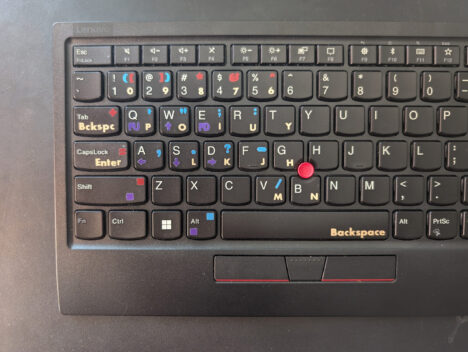
As a writer, my most persistent post-injury dread concerned my ability to pursue this profession (and passion). So I started researching and testing adaptive keyboards for one-handed users, then wound up developing a single-handed typing system for two-handed keyboards — one that I could share with others, and have below!
Part 1 – Adaptive Keyboards & Writing Technologies for Single-Handed Use: Despite the wide range of available designs, one-handed keyboards have various drawbacks that can be dealbreakers for some users.
Part 2 – Designing a Single-Handed Keymap for Half of a Standard Keyboard: Ultimately, I created a new custom typing solution, programmed to enable one-handed touch-typing on a standard two-handed keyboard.
Part 3 – Setting Up a Free One-Handed Touch-Typing System in Minutes: The “KURTY” keymap adds single-handed functionality to QWERTY keyboards in minutes — and it’s free for you to download and use.
Encore! Roman & Kurt Discuss Adapt or Design
For the concluding episode, we were originally planning to talk primarily about adaptive technologies, but the conversation between me and Roman expanded to encompass a broader range of accessible designs.
Postscript: Adapting, Designing, … and Writing

I set out to write a single article about accessible design, to be paired with an episode about one-handed keyboards. As I developed my own adaptive writing solution, however, putting my experiences down on (proverbial) paper became easier … and the scope started to expand. I continue to recover slowly and incrementally from my injury, but am still limited to typing with my non-dominant left hand (and may be forever). So I continue to find my custom keyboard setup useful and hope others who download it will as well.
Meanwhile, I sincerely and deeply appreciate the support I’ve gotten not only from my colleagues, friends, family, and partner, but also from the many WU and 99pi fans who have engaged with and responded to this series. Thank you all!

